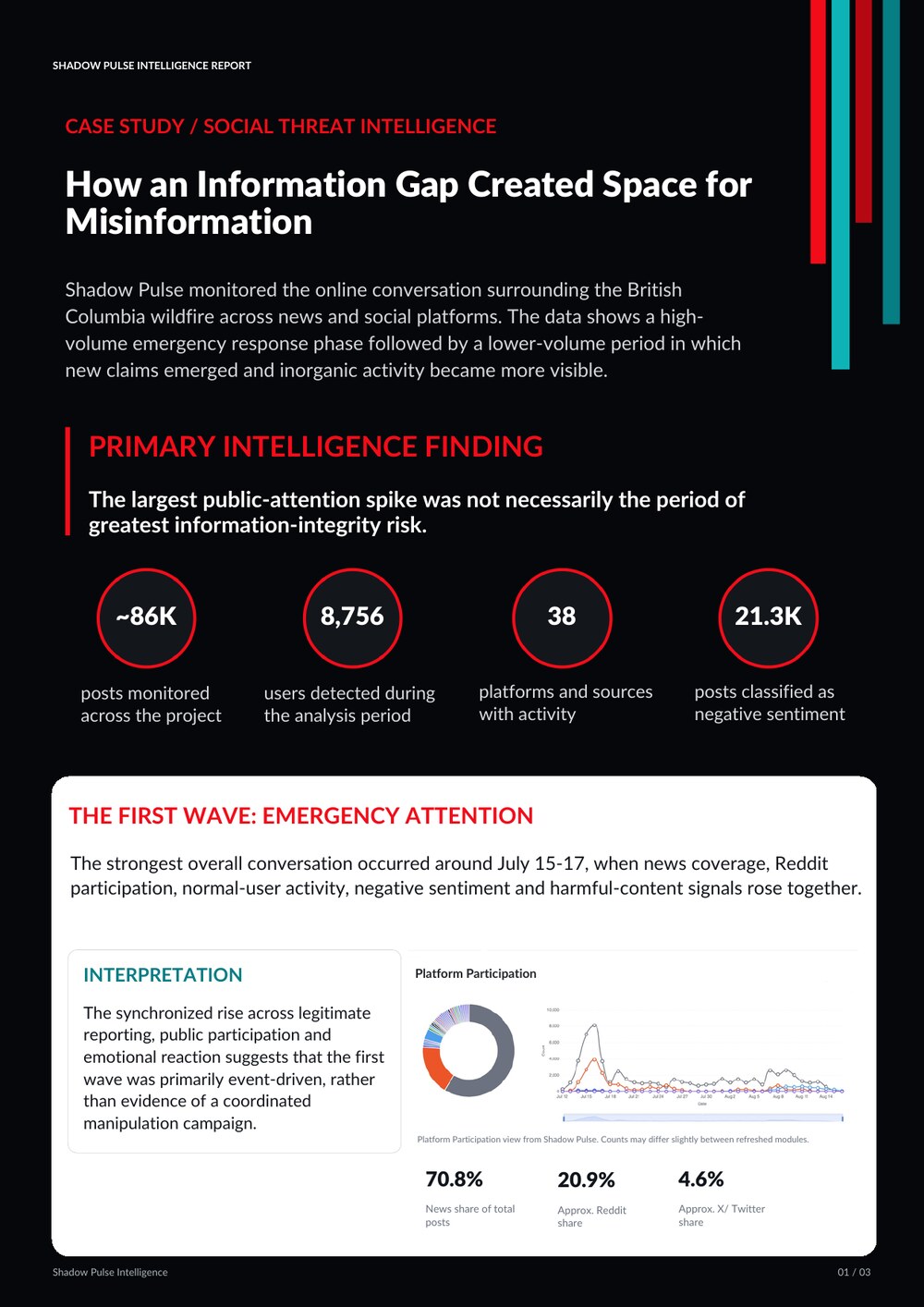
Shadow Pulse monitored the online conversation surrounding the British Columbia wildfires across news and social platforms between July 13 and August 17, 2026. The data shows a high-volume emergency response phase, followed by a lower-volume period in which new claims emerged and inorganic activity became more visible.
posts monitored across the project
users detected during the analysis period
platforms and sources with activity
posts classified as negative sentiment
The largest public-attention spike was not necessarily the period of greatest information-integrity risk.
The first wave: emergency attention
The strongest overall conversation occurred around July 15–17, when news coverage, Reddit participation, normal-user activity, negative sentiment and harmful-content signals all rose together.
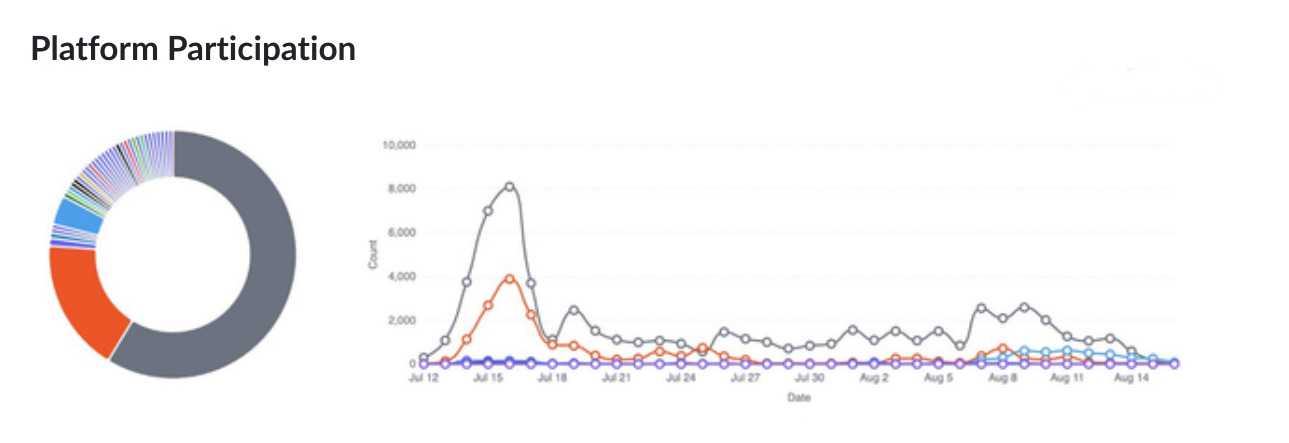
News share of total posts
Approx. Reddit share
Approx. X / Twitter share
The synchronized rise across legitimate reporting, public participation and emotional reaction suggests that the first wave was primarily event-driven, rather than evidence of a coordinated manipulation campaign.
From information gap to misinformation
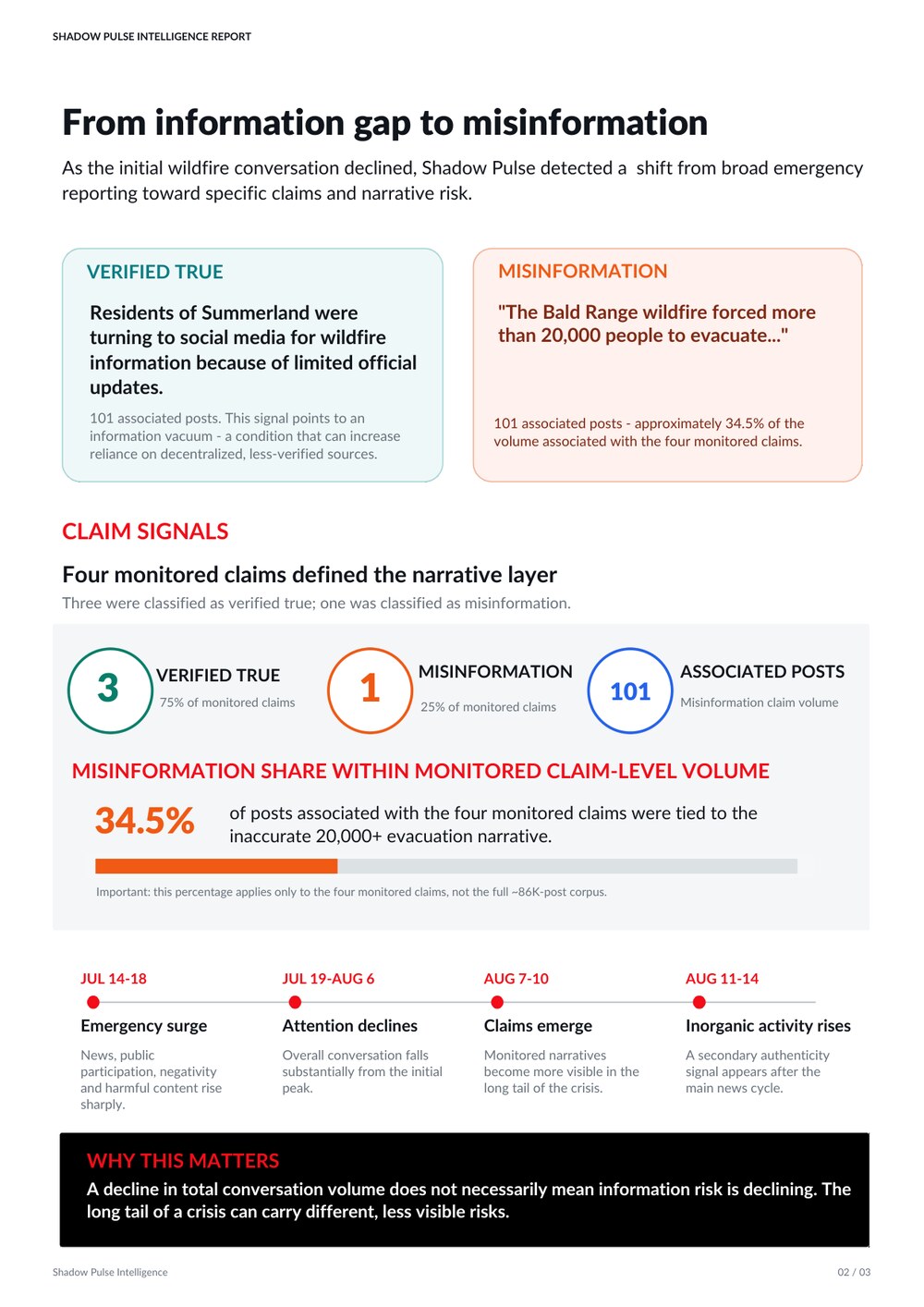
As the initial wildfire conversation declined, Shadow Pulse detected a shift from broad emergency reporting toward specific claims and narrative risk. Four claims defined the narrative layer — three classified as verified true, one classified as misinformation.
Residents of Summerland were turning to social media for wildfire information because of limited official updates.
101 associated posts. This signal points to an information vacuum — a condition that can increase reliance on decentralized, less-verified sources.
“The Bald Range wildfire forced more than 20,000 people to evacuate…”
101 associated posts — approximately 34.5% of the volume associated with the four monitored claims.
of posts associated with the four monitored claims were tied to the inaccurate 20,000+ evacuation narrative.
Important: this percentage applies only to the four monitored claims, not the full ~86K-post corpus.
How the crisis unfolded
| Window | Phase | What the data showed |
|---|---|---|
| Jul 14–18 | Emergency surge | News, public participation, negativity and harmful content rise sharply. |
| Jul 19–Aug 6 | Attention declines | Overall conversation falls substantially from the initial peak. |
| Aug 7–10 | Claims emerge | Monitored narratives become more visible in the long tail of the crisis. |
| Aug 11–14 | Inorganic activity rises | A secondary authenticity signal appears after the main news cycle. |
A decline in total conversation volume does not necessarily mean information risk is declining. The long tail of a crisis can carry different, less visible risks.
Inorganic activity rose after the main news cycle
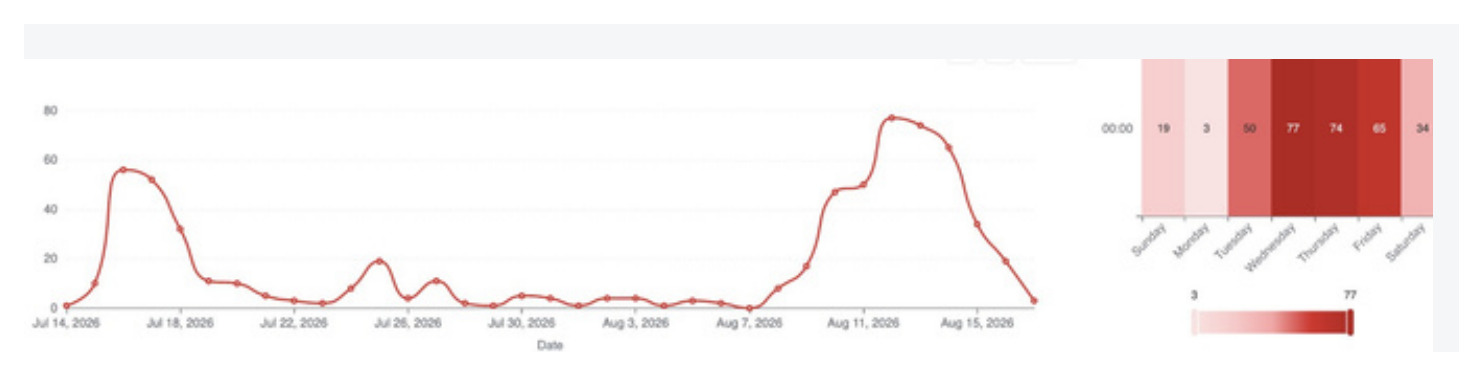
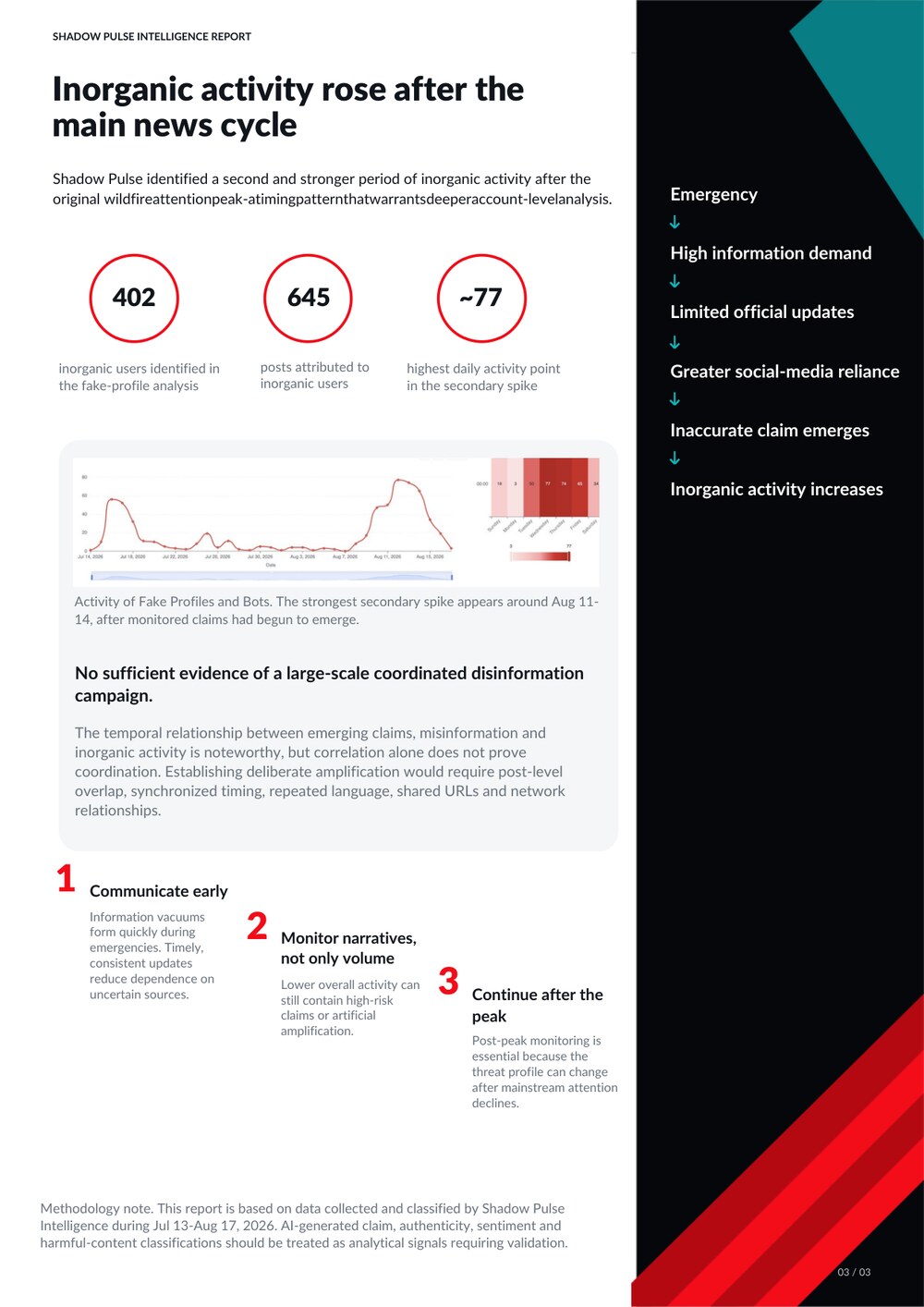
Shadow Pulse identified a second — and stronger — period of inorganic activity after the original wildfire attention peak. It is a timing pattern that warrants deeper account-level analysis.
inorganic users identified in the fake-profile analysis
posts attributed to inorganic users
highest daily activity point in the secondary spike
The sequence
Emergency → high information demand → limited official updates → greater social-media reliance → inaccurate claim emerges → inorganic activity increases.
No sufficient evidence of a large-scale coordinated disinformation campaign.
The temporal relationship between emerging claims, misinformation and inorganic activity is noteworthy, but correlation alone does not prove coordination. Establishing deliberate amplification would require post-level overlap, synchronized timing, repeated language, shared URLs and network relationships.
What this means for crisis communication
Communicate early
Information vacuums form quickly during emergencies. Timely, consistent updates reduce dependence on uncertain sources.
Monitor narratives, not only volume
Lower overall activity can still contain high-risk claims or artificial amplification.
Continue after the peak
Post-peak monitoring is essential because the threat profile can change after mainstream attention declines.
Read the full report
The complete Shadow Pulse intelligence report is reproduced below, and available as a PDF.
Methodology note. This report is based on data collected and classified by Shadow Pulse Intelligence during Jul 13 – Aug 17, 2026. AI-generated claim, authenticity, sentiment and harmful-content classifications should be treated as analytical signals requiring validation.
#shadowpulse #narrativeintelligence #misinformation #digitalrisk | Shadow Pulse Intelligence